
· Sylvia
Fuel Decarbonisation and War-Driven Energy Shocks
Energy security, low-carbon transitions and lessons from the Russia–Ukraine crisis
Key highlights
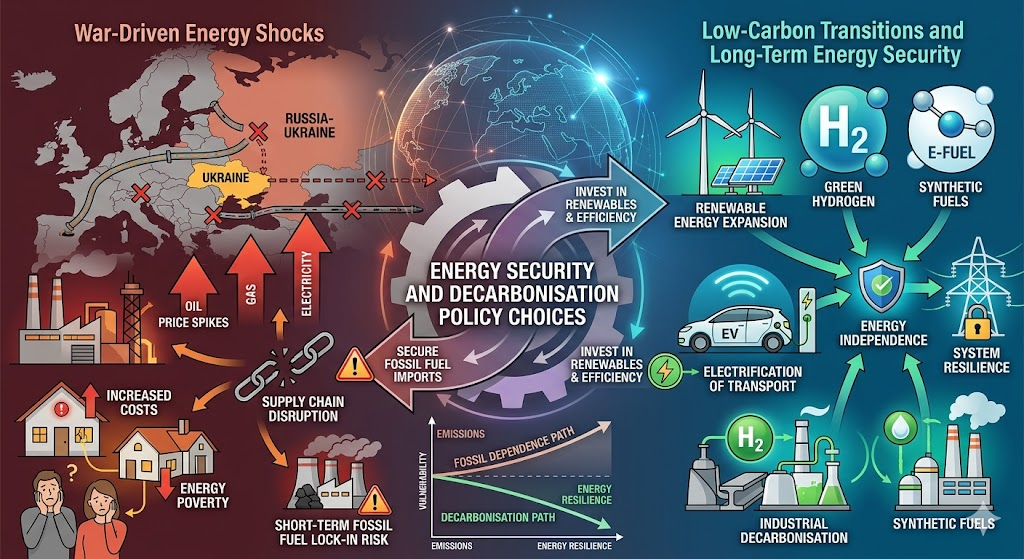
War-driven energy shocks have exposed the vulnerability of global fossil fuel systems while testing the resilience of low-carbon transitions. The Russia–Ukraine war caused major increases in oil, gas and electricity prices, widespread energy insecurity, and economic disruption across importing nations. Research shows that while these shocks produced modest short-term reductions in CO₂ emissions through lower gas consumption and fuel switching, they do not automatically accelerate decarbonisation. Long-term progress depends on whether governments respond through renewable energy expansion, electrification, hydrogen and e-fuel investment — or instead reinforce fossil fuel dependence through short-term energy security measures.
Energy systems are geopolitical systems
Global energy systems are deeply interconnected with geopolitics. Armed conflicts, sanctions and trade disruptions can rapidly destabilise energy markets, creating serious economic and environmental consequences. The Russia–Ukraine war became one of the most significant energy shocks in recent history, severely disrupting oil, gas and coal markets while reshaping debates around energy security and fuel decarbonisation [1,2].
The conflict highlighted how strongly modern economies depend on stable fossil fuel supplies. Europe was particularly vulnerable due to its heavy reliance on Russian natural gas imports. Following the invasion, energy prices rose sharply and volatility increased across global markets [2,3]. Oil and gas price fluctuations persisted long after the initial supply disruptions, creating uncertainty for governments, businesses and households [7]. Many countries experienced rising inflation, slower economic growth and increased welfare losses, while some fossil fuel exporters benefited from higher global prices [2,3,6].
Alongside economic disruption, the crisis intensified energy poverty and cost-of-living pressures. Higher heating, electricity and food prices placed additional strain on households worldwide [5]. Studies examining the broader geopolitical impacts of the war found that global supply chain interruptions exposed weaknesses in energy security systems and demonstrated how dependent many economies remain on imported fossil fuels [4].
Did the crisis actually cut emissions?
Although the crisis created major economic challenges, several studies suggest it also produced small reductions in carbon emissions in the short to medium term. Reduced industrial activity, lower gas demand and shifts away from gas-fired electricity generation contributed to modest emission cuts [3,4].
One EU-focused scenario estimated that global CO₂ emissions could decline by approximately 1% by 2030 due to reduced gas use and fuel switching patterns [3]. However, researchers emphasise that sanctions and trade disruptions alone generate only limited carbon abatement, with most studies showing reductions below 1% even under strict scenarios [4].
Do energy shocks accelerate or delay the transition?
The key question emerging from recent research is whether energy shocks accelerate or delay decarbonisation. Early in the crisis, many analysts argued that the war could become a turning point for clean energy transitions by exposing the risks of fossil fuel dependence and strengthening support for renewable energy and efficiency measures [1].
Evidence since then has shown mixed outcomes. In many high-income economies, geopolitical tensions encouraged greater investment in renewable energy systems as governments sought to improve energy independence and reduce exposure to imported fossil fuels [8]. Expanding solar, wind and electrification programmes became increasingly linked to national energy security strategies.
However, prolonged uncertainty can also discourage investment. Research focused on G7 economies found that while energy uncertainty initially stimulated renewable energy deployment, geopolitical conflict and militarisation eventually reduced growth in both renewable and non-renewable energy development [9]. Investors became more cautious as volatility increased across global energy markets.
These tensions reveal a major challenge in balancing immediate energy security with long-term climate goals. During the crisis, many governments prioritised securing short-term fossil fuel supplies through alternative gas imports, expanded LNG infrastructure, nuclear extensions and, in some cases, temporary increases in coal use [1,3,5]. While these measures stabilised energy systems in the short term, researchers warn they risk creating new fossil fuel “lock-ins” that could delay decarbonisation for decades [6].
Low-carbon fuels: electrification, hydrogen and e-fuels
At the same time, the crisis renewed attention on alternative low-carbon fuel systems that could improve both sustainability and energy resilience. Several studies highlight the growing importance of electrification, hydrogen and synthetic fuels in future decarbonisation pathways [10,11].
Integrated modelling of global transport systems suggests that electrification will dominate road transport decarbonisation because electric vehicles are increasingly efficient and cost-effective [10]. However, sectors such as aviation, shipping and heavy freight remain difficult to electrify directly due to their high energy density requirements. For these sectors, biofuels, hydrogen and synthetic e-fuels are expected to play critical roles [11].
Green hydrogen has emerged as one of the most important technologies for hard-to-decarbonise sectors. Produced using renewable electricity, hydrogen can replace fossil fuels in industrial processes, transport and energy storage systems [13]. Researchers are also exploring synthetic fuels such as e-methanol, e-ammonia, e-diesel and e-kerosene, which can be produced through power-to-fuel (PtF) and power-to-gas (PtG) systems using renewable electricity and captured carbon [12,13,14,15].
These fuels offer several advantages. They can use existing transport and storage infrastructure while reducing emissions in sectors where electrification is impractical. They can also improve long-duration energy storage and strengthen energy system flexibility [14]. However, major challenges remain: green hydrogen and synthetic fuel production require very large amounts of renewable electricity, and costs remain significantly higher than conventional fossil fuels [13,14].
Industrial decarbonisation presents further difficulties. Heavy industries such as steel, cement and chemical manufacturing require extremely high-temperature processes that are difficult to electrify directly. Hydrogen is increasingly viewed as a key solution for these sectors, but current hydrogen production remains heavily dependent on fossil fuels [16]. Large-scale deployment also requires extensive new infrastructure, including pipelines, storage facilities and renewable electricity generation capacity.
Policy: treating climate and resilience as one problem
The Russia–Ukraine crisis demonstrates that decarbonisation and energy security are increasingly interconnected. Many studies argue that future policy should focus on integrating climate goals with resilience planning rather than treating them as separate challenges [1,8].
Recommended policy responses include:
accelerating renewable energy deployment and improving energy efficiency
diversifying energy suppliers and technologies
expanding strategic reserves
supporting vulnerable households during periods of price volatility [1,5,8,9]
Researchers also stress the importance of long-term investment in hydrogen, synthetic fuels and supporting infrastructure aligned with climate targets, rather than short-term fossil fuel expansion [11,13,16].
A real-world stress test
Overall, recent research shows that war-driven energy shocks strongly destabilise global fuel markets and create widespread economic and social pressures. While crises may produce temporary reductions in emissions through lower demand and fuel switching, they do not automatically drive deep decarbonisation. The long-term outcome depends heavily on policy choices.
Where governments link energy security with renewable energy expansion, electrification and low-carbon fuel investment, geopolitical crises can accelerate the transition to cleaner energy systems. Where responses focus mainly on securing alternative fossil fuel supplies, there is a significant risk of reinforcing long-term fossil fuel dependence.
The Russia–Ukraine war has therefore become a real-world stress test for global decarbonisation strategies. Its lessons suggest that future resilience will depend not only on securing energy supplies, but on transforming energy systems toward cleaner, more diversified and sustainable pathways.
References
Zakeri, B. et al. (2022). Pandemic, war, and global energy transitions. Energies. doi:10.3390/en15176114
Sun, M. et al. (2024). The Russia–Ukraine conflict, soaring international energy prices, and implications for global economic policies. Heliyon, 10. doi:10.1016/j.heliyon.2024.e34712
Hartvig, Á. et al. (2024). The economic and energy security implications of the Russian energy weapon. Energy. doi:10.1016/j.energy.2024.130972
Cui, L. et al. (2023). Exploring the risk and economic vulnerability of global energy supply chain interruption in the context of the Russo-Ukrainian war. Resources Policy. doi:10.1016/j.resourpol.2023.103373
(2022). The Ukraine war and threats to food and energy security: cascading risks from rising prices and supply disruptions. doi:10.55317/9781784135225
Wei, J. (2023). The economic impact of geopolitical conflict: energy, markets, and policy recommendations. Advances in Economics, Management and Political Sciences. doi:10.54254/2754-1169/30/20231462
Enescu, A. & Szeles, M. (2023). Discussing energy volatility and policy in the aftermath of the Russia–Ukraine conflict. Frontiers in Environmental Science. doi:10.3389/fenvs.2023.1225753
Cheikh, B. N. & Ben Zaied, Y. (2023). Renewable energy deployment and geopolitical conflicts. Journal of Environmental Management, 344, 118561. doi:10.1016/j.jenvman.2023.118561
Yasmeen, R. & Shah, W. U. H. (2024). Energy uncertainty, geopolitical conflict, and militarization matters for renewable and non-renewable energy development: perspectives from G7 economies. Energy. doi:10.1016/j.energy.2024.132480
Speizer, S. et al. (2024). Integrated assessment modeling of a zero-emissions global transportation sector. Nature Communications, 15. doi:10.1038/s41467-024-48424-9
Gray, N. et al. (2021). Decarbonising ships, planes and trucks: an analysis of suitable low-carbon fuels for the maritime, aviation and haulage sectors. Advances in Applied Energy. doi:10.1016/j.adapen.2021.100008
Uchida, N. et al. (2025). E-fuels in IC engines: a key solution for a future decarbonized transport. International Journal of Engine Research, 26, 1675–1702. doi:10.1177/14680874251325296
Nemmour, A. et al. (2023). Green hydrogen-based e-fuels (e-methane, e-methanol, e-ammonia) to support clean energy transition: a literature review. International Journal of Hydrogen Energy. doi:10.1016/j.ijhydene.2023.03.240
Dell'Aversano, S. et al. (2024). E-fuels: a comprehensive review of the most promising technological alternatives towards an energy transition. Energies, 17, 3995. doi:10.3390/en17163995
Rozzi, E. et al. (2020). Green synthetic fuels: renewable routes for the conversion of non-fossil feedstocks into gaseous fuels and their end uses. Energies, 13, 420. doi:10.3390/en13020420
Griffiths, S. et al. (2021). Industrial decarbonization via hydrogen: a critical and systematic review of developments, socio-technical systems and policy options. Energy Research & Social Science, 80, 102208. doi:10.1016/j.erss.2021.102208
Adma, A. & Hanita, M. (2025). Geopolitics tension, wars and its impact on energy/oil crisis: Russia–Ukraine war case study. Interdisciplinary Journal and Humanity (INJURITY). doi:10.58631/injurity.v4i5.1434