
· AishaniP.
Visualising Steel’s Carbon Footprint
A Systems View Across Scopes 1–3
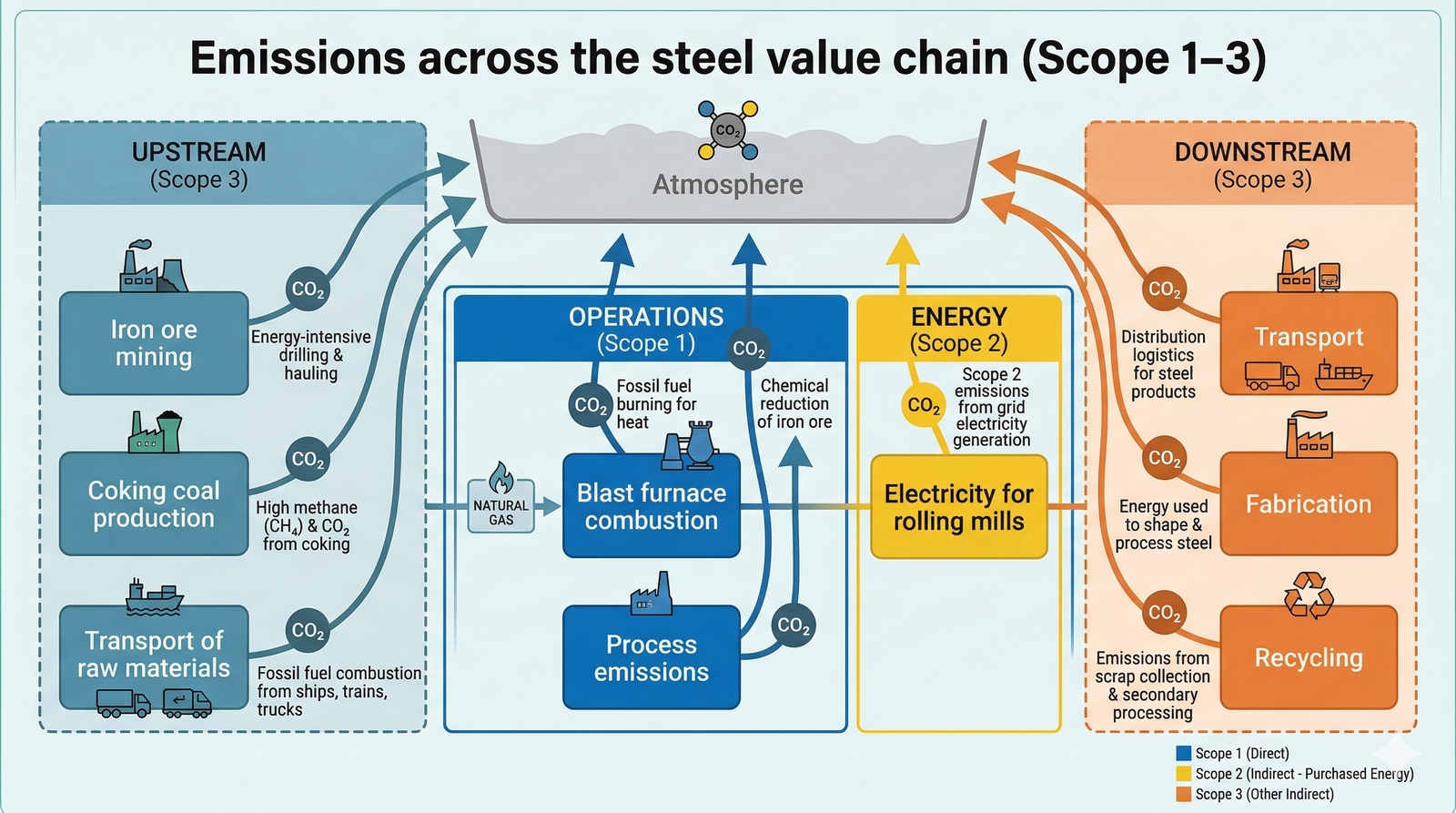
Decarbonising heavy industry is often framed as a technological challenge. In reality, it is fundamentally a systems transformation problem. Among industrial sectors, steel occupies a particularly important position: global steel production generates approximately 7–9% of global CO₂ emissions, making it one of the most carbon-intensive materials in the global economy (International Energy Agency, 2023; World Steel Association, 2022).
The diagram “Emissions across the steel value chain (Scope 1–3)” offers a structured way to visualise this challenge. Rather than isolating emissions within the steel plant itself, the map traces greenhouse gas emissions across the entire value chain of steel production and use, spanning material extraction, energy systems, manufacturing, logistics, and recycling.
When viewed through the lens of Life Cycle Assessment (LCA) and Product Carbon Footprints (PCFs), the diagram effectively illustrates the system boundaries that define the climate impact of steel products (International Organization for Standardization, 2018). This perspective highlights a key insight: the decarbonisation of steel cannot occur solely within the boundaries of the steel plant. Instead, it requires coordinated action across energy systems, supply chains, industrial processes, and product design.
Framing Steel Emissions Through the GHG Protocol
The diagram follows the accounting structure established by the Greenhouse Gas Protocol, which categorises emissions into three distinct scopes (WRI & WBCSD, 2011).
Scope 1 – Direct emissions
These emissions arise from sources directly owned or controlled by the steel producer, including fuel combustion and chemical reactions within steelmaking processes.
Scope 2 – Indirect emissions from purchased energy
Scope 2 emissions arise from the generation of electricity, steam, or heat purchased by the steel plant.
Scope 3 – Value chain emissions
Scope 3 emissions encompass all remaining lifecycle emissions occurring upstream and downstream of steel production, including raw material extraction, transport, fabrication, product use, and recycling.
For many steel products, Scope 3 emissions represent a substantial share of total lifecycle emissions, reinforcing the need for value-chain decarbonisation strategies.
Upstream Emissions: Materials, Methane, and Global Supply Chains
The upstream segment of the steel value chain encompasses emissions associated with raw material extraction and transport. These emissions occur outside the direct operational control of steel manufacturers but remain closely tied to procurement strategies and supplier relationships.
Iron Ore Extraction
Steel production begins with iron ore mining, which typically involves large-scale open-pit mining operations powered by diesel-based heavy equipment such as haul trucks, excavators, and drilling rigs.
Mining operations therefore generate significant emissions through fossil fuel combustion. Emerging decarbonisation pathways include:
Electrified mining equipment
Hydrogen-powered heavy machinery
Renewable energy integration in mining operations
Such measures could significantly reduce embedded upstream emissions within steel supply chains (IEA, 2023).
Coking Coal and Methane Emissions
Traditional blast furnace steelmaking relies on coking coal as both a fuel and a chemical reducing agent. However, coal mining introduces an additional climate risk through methane emissions.
Methane (CH₄) has a global warming potential approximately 28–34 times greater than CO₂ over a 100-year period (Intergovernmental Panel on Climate Change, 2021).
Coal mines release methane through:
Fugitive emissions
Ventilation systems
Abandoned mine shafts
Reducing methane leakage through monitoring, capture technologies, and regulatory oversight is therefore an important upstream mitigation opportunity.
Transport of Raw Materials
Iron ore and coal often travel thousands of kilometres before reaching steel plants, relying on global logistics networks consisting of:
Bulk maritime shipping
Rail freight
Heavy-duty trucking
These logistics systems remain heavily dependent on fossil fuels. Potential decarbonisation pathways include:
Electrified rail networks
Hydrogen-powered freight transport
Low-carbon marine fuels such as ammonia and methanol
These changes are essential for reducing supply chain emissions embedded in steel production.
Steel Production: Process and Energy Emissions
The steel plant represents the central stage of the value chain and is responsible for the majority of direct emissions associated with steelmaking.
Two major emission categories dominate: process emissions (Scope 1) and electricity consumption (Scope 2).
Scope 1: Process Emissions from Iron Reduction
Conventional steel production follows the blast furnace–basic oxygen furnace (BF-BOF) route, which relies on coke and coal to reduce iron ore into molten iron.
This process generates emissions through two mechanisms.
Combustion emissions
Coke and coal are burned to produce temperatures exceeding 1,500°C, releasing large quantities of CO₂.
Chemical reduction emissions
The reduction reaction itself generates CO₂:
Fe₂O₃ + 3CO → 2Fe + 3CO₂
This reaction highlights a structural challenge in steelmaking: carbon is embedded within the chemistry of the production process itself.
Addressing these emissions requires alternative technologies such as:
Hydrogen-based direct reduction (H₂-DRI)
Electrolytic ironmaking
Carbon capture, utilisation and storage (CCUS)
Hydrogen-based steelmaking is increasingly considered one of the most promising pathways for achieving near-zero emissions steel (Vogl et al., 2018).
Major pilot projects include initiatives by companies such as:
SSAB through the HYBRIT project
H2 Green Steel in Sweden
These projects demonstrate how renewable hydrogen could replace coal as the reducing agent in steelmaking.
Scope 2: Electricity Consumption
Steel plants require substantial electricity for downstream operations including:
Continuous casting
Rolling mills
Finishing and shaping processes
The carbon intensity of these activities depends heavily on the electricity grid mix.
Steel plants operating in regions with fossil-heavy power systems inherit higher indirect emissions, whereas those using renewable electricity can significantly reduce Scope 2 emissions.
Corporate power purchase agreements and renewable electricity procurement are therefore becoming increasingly common in industrial decarbonisation strategies.
Downstream Emissions: Fabrication, Use, and Circularity
Once steel leaves the production facility, emissions continue across downstream activities.
Distribution and Logistics
Finished steel products are transported to industries such as:
Construction
Automotive manufacturing
Infrastructure development
These distribution systems contribute additional emissions from shipping, rail, and trucking.
Fabrication and Manufacturing
Steel is rarely used in its primary form. Instead, manufacturers must process it further through:
Cutting
Welding
Forming
Assembly
These activities require energy and therefore contribute to the overall lifecycle emissions of steel products.
Recycling and the Circular Economy
Steel is one of the most recyclable materials in the global economy. Scrap steel can be remelted using Electric Arc Furnaces (EAFs), which require significantly less energy than primary blast furnace production.
However, recycling still generates emissions through:
Scrap collection
Sorting and processing
Electricity used in remelting
When powered by renewable electricity, EAF-based steel production offers one of the most effective pathways toward low-carbon steel production.
Product Carbon Footprints and Embodied Carbon
The emissions illustrated across the steel value chain ultimately contribute to the Product Carbon Footprint (PCF) of steel products.
Under ISO 14067, a product carbon footprint represents the total lifecycle greenhouse gas emissions associated with a product, including raw materials, manufacturing, transport, use, and end-of-life stages.
For steel products, these lifecycle emissions are increasingly relevant for sectors such as:
Construction
Automotive manufacturing
Infrastructure development
Embodied carbon in materials has therefore become a key focus in climate policy discussions.
Policy Drivers: Trade, Regulation, and Carbon Pricing
Policy frameworks are increasingly shaping the future of low-carbon steel.
One notable policy instrument is the Carbon Border Adjustment Mechanism, introduced by the European Union.
The mechanism places a carbon price on imported steel based on its embedded emissions, aiming to prevent carbon leakage and incentivise low-carbon production globally.
Such policies are expected to accelerate investment in green steel technologies and low-carbon supply chains.
Green Steel Markets and Economic Transitions
The transition to low-carbon steel will also reshape industrial economics.
Early analyses suggest that hydrogen-based steel production could increase steel production costs by 20–40% initially, although costs may decline as hydrogen and renewable electricity prices fall (IEA, 2023).
This creates a potential “green steel premium”, where buyers—particularly in automotive and construction sectors—pay a higher price for low-carbon steel.
Several multinational companies have already begun signing green steel procurement agreements as part of corporate decarbonisation strategies.
A Systems Transition for Industrial Decarbonisation
The central insight of the steel emissions map is that decarbonisation cannot be solved through isolated technological improvements.
Instead, the transition requires coordinated action across multiple interconnected systems:
Mining and raw material supply chains
Energy systems and electricity generation
Industrial production technologies
Global transport networks
Product design and circular material flows
The decarbonisation of steel therefore represents not only a technological shift but also a structural transformation of the global industrial economy.
Understanding where emissions occur across the value chain is the first step toward designing interventions capable of delivering a low-carbon future for one of the world’s most essential materials.
References
International Energy Agency (2023). Iron and Steel Technology Roadmap.
Intergovernmental Panel on Climate Change (2021). Sixth Assessment Report.
ISO (2018). ISO 14067: Carbon Footprint of Products.
Vogl, V., Åhman, M., & Nilsson, L. (2018). Hydrogen-based reduction of iron ore. Journal of Cleaner Production.
World Steel Association (2022). Climate Action in the Steel Industry.
WRI & WBCSD (2011). GHG Protocol Corporate Value Chain Standard.
AI Use
AI tools may be used to assist with certain aspects of producing this newsletter, including:
editing and refining written drafts
improving structure and readability
generating diagrams or illustrative visuals
helping format presentations or conceptual maps
These tools function as assistive writing and design tools, similar to a digital editor.
All substantive analysis, arguments, and interpretations remain my own.